Page 1 of 2
Effect of kinematic nonlinearity on pushdown analysis
Posted: Tue Oct 22, 2024 5:05 pm
by Sylwester
Dear STKO
I wanted to go back to modeling with asdshellq4 and investigate the effect of geometric nonlinearity on the ultimate load carrying capacity of the structure
I made 2 of the same models changing only the kinematics to corotation
A 9x6 m slab with a unit force of q=1 kN/m^2. Displacement control in the midle
Below is the obtained pushdown curve
a) Linear kinematics
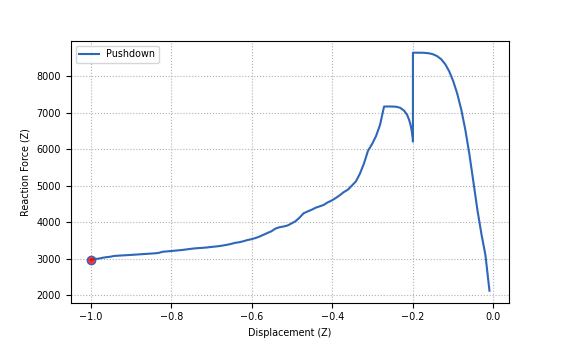
- Linear.png (28.31 KiB) Viewed 867 times
b) corotational
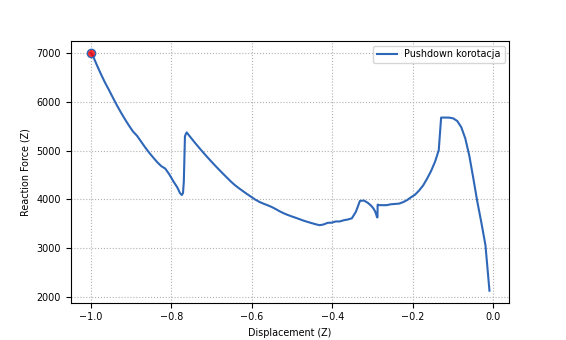
- COROTATIONAL.png (30.72 KiB) Viewed 867 times
I used the Krylov Newton method. Can you please check if the analysis settings are correct? By setting a different algorithm the procedure ends at the first break of the curve.
I don't understand why there is such a hardening in the case of corotation at the end of the analysis.
Maybe I should use a different algorithm ? or the results obtained are correct ? Corotation introduces additional axial forces, which should increase the maximum load capacity.
2 more technical questions
1. Using MP what can be the maximum number of partitions? As many cores as my processor has?
2. Asd Concrete3D density. When Im modeling in kN/m^3 should te value be 2.5 for concrete?
Best regards
Re: Effect of kinematic nonlinearity on pushdown analysis
Posted: Wed Oct 23, 2024 10:32 am
by STKO Team
Google for "Slab catenary action"
Re: Effect of kinematic nonlinearity on pushdown analysis
Posted: Wed Oct 23, 2024 10:46 am
by Sylwester
I see that the shape of the curve (corotationaL) is similar to the obtianed for example:
https://dr.ntu.edu.sg/bitstream/10356/8 ... itions.pdf
By changing the algorithm to any other (except Krylov), the analyses end with the first displacement jump.
What I don't understand is why there is so much hardening in corotation despite the min max command for steel.
Re: Effect of kinematic nonlinearity on pushdown analysis
Posted: Wed Oct 23, 2024 4:25 pm
by kesavapraba
What I don't understand is why there is so much hardening in corotation despite the min max command for steel.
Are you sure that the rebar strain, both in top and bottom bars during the hardening stage, is reached its fracture strain (0.1 as per your model)? If not, the hardening will happen, because, the top bar (initially in compression and during hardening in tension) will now undergo tension under catenary action and provide resistance until it fractures! Please check the strain values.
1. Using MP what can be the maximum number of partitions? As many cores as my processor has?
Yes, you can do that.
2. Asd Concrete3D density. When Im modeling in kN/m^3 should te value be 2.5 for concrete?
Yes, I assume that the unit weight of concrete is 25 kN/m^3 here.
Re: Effect of kinematic nonlinearity on pushdown analysis
Posted: Wed Oct 23, 2024 8:02 pm
by Sylwester
Hi, thanks for the feedback,
I made another example but with lower reinforcment, I changed it to fi 10 mm. I pushed the structure to about 2 m.
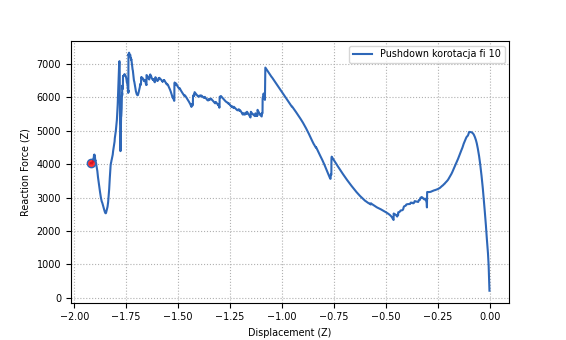
- corotational fi 10.png (36.69 KiB) Viewed 812 times
In addition, to increase the clarity of the results, I copied the direction of the 0 and 90 degree reinforcement to the bottom and top reinforcment
Going to the fiber results and check the strain of the top reinforcement reaches it over 0.1 (my min max).

- strain 1.jpg (187.16 KiB) Viewed 812 times
I thought the min max command means that in a given time step I exceed the strain value of 0.1 (min max) then in the next time step this value should drop to zero? Simulating the fracture of rebars ?
https://opensees.berkeley.edu/wiki/inde ... x_Material
Re: Effect of kinematic nonlinearity on pushdown analysis
Posted: Thu Oct 24, 2024 9:02 am
by STKO Team
I thought the min max command means that in a given time step I exceed the strain value of 0.1 (min max) then in the next time step this value should drop to zero? Simulating the fracture of rebars ?
Yes, that's why you see those progressive load drops
Re: Effect of kinematic nonlinearity on pushdown analysis
Posted: Thu Oct 24, 2024 11:05 am
by Sylwester
I understand, but that is not what I am asking.
I am referring to the results in the MPCO recorder. Why is e11 (or e22) for steel greater than 0.1? Shouldn't there be a zero value in the subsequent time steps after 0.1 is exceeded?
Something like this?:
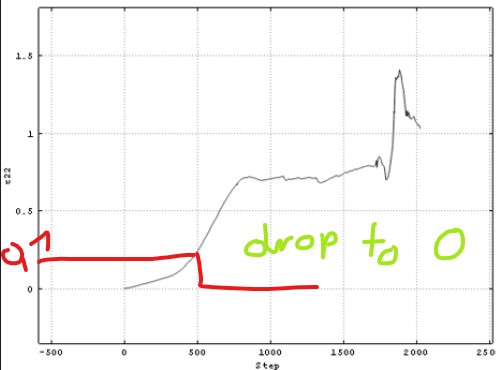
- e22 vs time step.jpg (27.59 KiB) Viewed 784 times
Re: Effect of kinematic nonlinearity on pushdown analysis
Posted: Thu Oct 24, 2024 4:05 pm
by kesavapraba
Hi, the stress becomes zero after reaching the e22=0.1! Not the strain - this will keep on increasing. Please have a look at the materials monotonic response to understand it better.
Re: Effect of kinematic nonlinearity on pushdown analysis
Posted: Fri Oct 25, 2024 8:30 am
by STKO Team
Exactly, the stress drops to zero (to represent a complete fracture failure), but the strain increases, as the crack opening increases.
Re: Effect of kinematic nonlinearity on pushdown analysis
Posted: Fri Oct 25, 2024 8:46 am
by Sylwester
Thanks for your help.
Best regards.