Page 2 of 4
Re: Settlement Analysis of a Masonry Building
Posted: Mon Feb 27, 2023 12:01 pm
by LJC
Thank you so much for the response! However I dont think I can download the newer model as it is a .rar rather than a zipped .scd.
Re: Settlement Analysis of a Masonry Building
Posted: Mon Feb 27, 2023 2:54 pm
by STKO Team
it's a zipped SCD file anyway. Just use tools such as 7zip to unzip it
Re: Settlement Analysis of a Masonry Building
Posted: Mon Feb 27, 2023 3:24 pm
by LJC
My mistake!
Re: Settlement Analysis of a Masonry Building
Posted: Tue Feb 28, 2023 11:10 am
by LJC
Since I am still having issues with convergence half way through the third analysis step, what steps can I take to solve this, would it be an appropriate solution to simply the model?
Additionally, I have a question: is it possible to change material properties during the analysis, for example changing the shear modulus of soil during the analysis.
Thank you!
Re: Settlement Analysis of a Masonry Building
Posted: Tue Feb 28, 2023 3:31 pm
by ValentinaSB
Always try to look at the post-processor. Look what is happening to your model when you have a convergence problem. You can also increase the scale in some cases to see it better. Now I can see that by applying settlements you have a failure of walls and the beams under the doors. Is it what you expected?
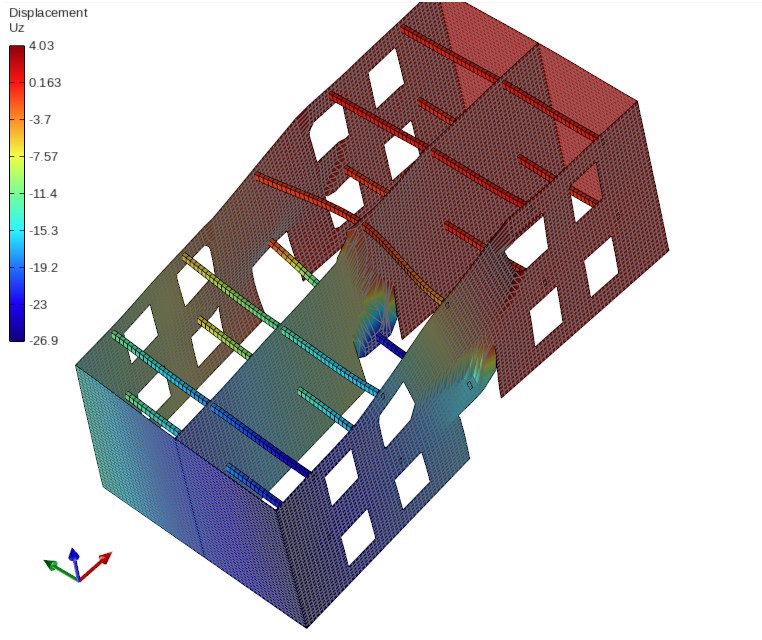
- stage3.jpg (122.84 KiB) Viewed 2719 times
Regarding changing material properties during the analysis, yes, it should be possible by writing a TCL script and using it through a custom command in Misc_commands in the analysis steps.
For example, look at this webinar where Dr.Petracca shows how to change initial stress for a prestressed beam.
https://youtu.be/oXi55FwpOI0
43:24 Third Example - Model prestressed Beam by explicitly drawing the cables
Best,
Valentina
Re: Settlement Analysis of a Masonry Building
Posted: Mon Mar 06, 2023 12:44 pm
by LJC
Thank you, will watch the webinar, I am aiming to do change soil properties during settlement to investigate the effect. I have alterted my model, as I do not want to see failure that early at an opening, in my new model however I still see convergence issues very quickly, when looking at the post processor it appears that the largest damage is seen above the window openings, but it does not look enough to fail and cause convergence issues.
I also am confused, as when imposing the displacement on the wall even though only 7 percent of the duration can run, the displacments are much greater than I would expect (80mm vs 7 percent of 100 mm), am I misunderstanding how the displacment is imposed or is there an error with the model.
Re: Settlement Analysis of a Masonry Building
Posted: Tue Mar 07, 2023 10:18 am
by LJC
I also have noticed that in my model, some of the zero values have non-zeroed, Is there an explnation to why this happens and if so how to fix it, as I am concerned that this will have implications on the zero-length contact between my building and soil model.
Re: Settlement Analysis of a Masonry Building
Posted: Tue Mar 07, 2023 1:26 pm
by ValentinaSB
LJC wrote: ↑Mon Mar 06, 2023 12:44 pm
I also am confused, as when imposing the displacement on the wall even though only 7 percent of the duration can run, the displacments are much greater than I would expect (80mm vs 7 percent of 100 mm), am I misunderstanding how the displacment is imposed or is there an error with the model.
You are using a load control integrator with a duration of 10 and a linear time series from 0 to 1. In this case, your U=Uref*lamda(t) is ten times your prescribed displacement. This is the reason you obtained so high displacements. Or use 1 for the duration or scale your time series to 0.1.
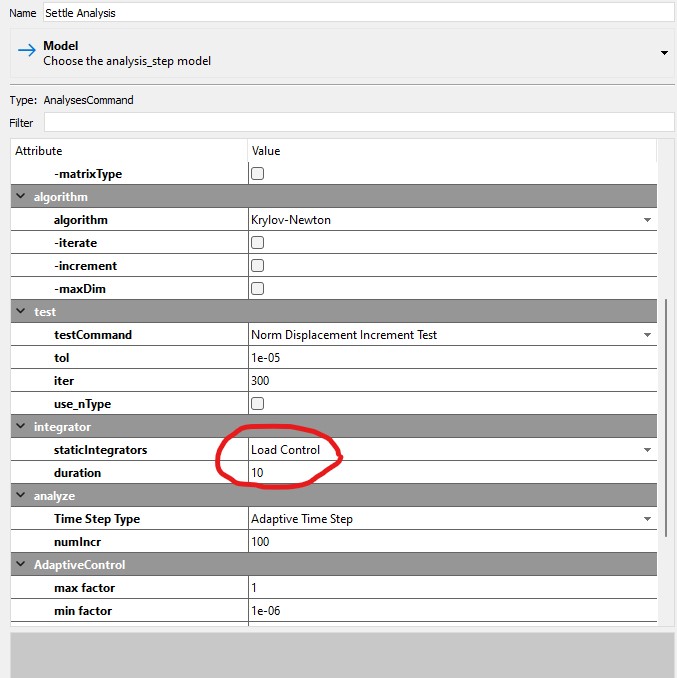
- Screenshot 2023-03-07 141805.jpg (79.77 KiB) Viewed 2687 times
LJC wrote: ↑Tue Mar 07, 2023 10:18 am
I also have noticed that in my model, some of the zero values have non-zeroed, Is there an explnation to why this happens and if so how to fix it, as I am concerned that this will have implications on the zero-length contact between my building and soil model.
What do you mean? Can you show me a screenshot?
Best,
Valentina
Re: Settlement Analysis of a Masonry Building
Posted: Tue Mar 07, 2023 1:47 pm
by LJC
Thank you so much! I have fixed the issue with the non-zero values for my geometries.
I have a further question, when making an interaction between two objects, for example this building and a soil domain, must the geometry nodes line up so that the elements have the correct number of nodes, or can they be considered as two distinct objects.
I am also trying to vary the values for soil properties along the x axis, I am currently discretising a linearly increasing youngs modulas along the x axis by cutting up my soil model into smaller soil blocks, this has the unforunate effect of drastically increasing the compelxity of the model so it takes much longer to run which is a problem for my computer. Is there a better method for approachingt this that you might know about, or is simply reducing the number of discretized steps the only approach to reduce computational cost.
I
Re: Settlement Analysis of a Masonry Building
Posted: Wed Mar 08, 2023 10:19 am
by ValentinaSB
LJC wrote: ↑Tue Mar 07, 2023 1:47 pm
I have a further question, when making an interaction between two objects, for example this building and a soil domain, must the geometry nodes line up so that the elements have the correct number of nodes, or can they be considered as two distinct objects.
It depends on the interaction that you use. In this case, you are using a contact element, so you need to have an aligned mesh, I mean you need to discretize your soli. Also if you have a very coarse mesh of the soil in the zone of interest it is probably not good for your analysis.
LJC wrote: ↑Tue Mar 07, 2023 1:47 pm
I am also trying to vary the values for soil properties along the x axis, I am currently discretising a linearly increasing youngs modulas along the x axis by cutting up my soil model into smaller soil blocks, this has the unforunate effect of drastically increasing the compelxity of the model so it takes much longer to run which is a problem for my computer. Is there a better method for approachingt this that you might know about, or is simply reducing the number of discretized steps the only approach to reduce computational cost.
To reduce the computational cost you can try to discretize a small volume of your soli and connect it with embed element to the rest of the soil. Give a look at this part of the webinar.
https://www.youtube.com/watch?v=oXi55FwpOI0
27:30 Second Example - Tie incompatible Mesh (tie)