Page 1 of 1
self-weight be applied to the boundary elements
Posted: Wed Jul 01, 2026 4:15 pm
by Alessandro2016
Dear STKO team
After applying self-weight to the ASDAbsorbingBoundary3D elements, I have tried various approaches, but the model fails to yield satisfactory results during the generation of the initial stress field. Therefore, I would like to ask you the following questions:
1) During the setup of the viscous boundaries, is it permissible not to apply gravity to the ASDAbsorbingBoundary3D elements? Would omitting gravity significantly affect the calculation results?
2) If applying self-weight to the ASDAbsorbingBoundary3D elements is indeed necessary, what is the proper method to establish a reasonable initial stress field? To my knowledge, no suitable method has been identified yet.
I hope my questions are clear. This issue has been troubling me for some time, and I look forward to your response!
Re: self-weight be applied to the boundary elements
Posted: Thu Jul 02, 2026 10:05 am
by STKO Team
Can you share your model to have a look?
Re: self-weight be applied to the boundary elements
Posted: Tue Jul 21, 2026 3:33 pm
by Alessandro2016
Thank you very much for your reply and the STKO team for their help during my study!
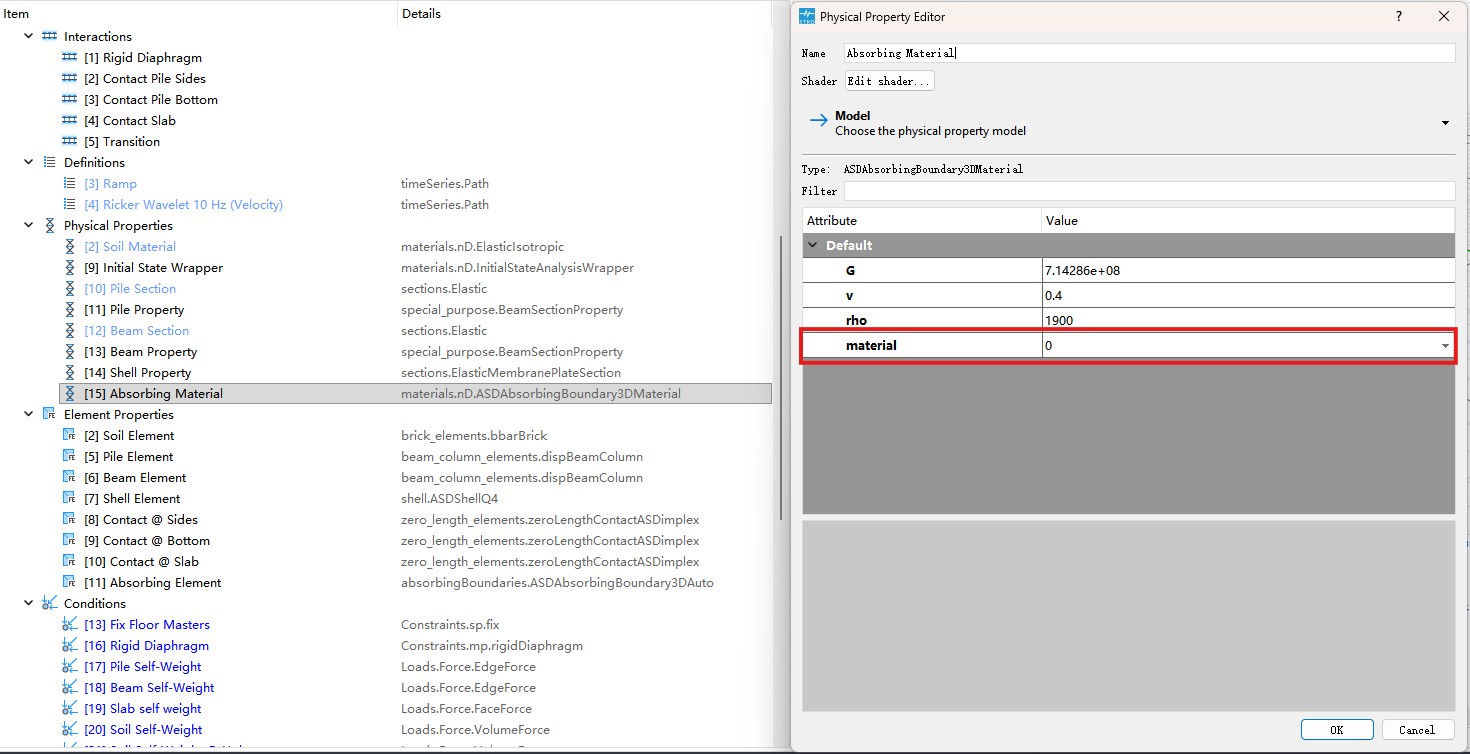
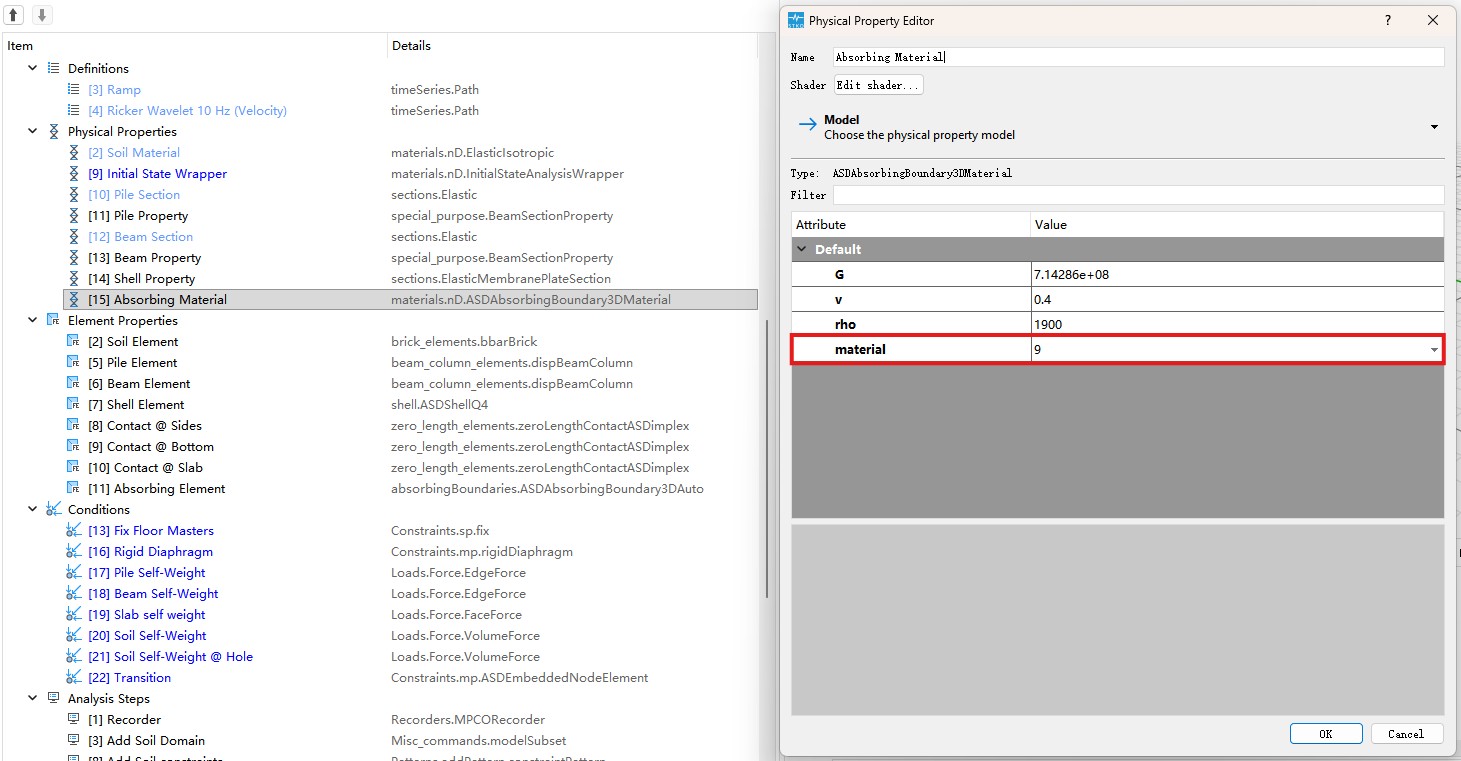
I created two models to investigate how adding self-weight to the AbsorbingBoundary3D element affects the results. The specific settings are shown in the figures below: Figure 1 shows the AbsorbingBoundary3D element without self-weight added, while Figure 2 shows the AbsorbingBoundary3D element with self-weight added.
figure1:
- figure1.jpg (178.33 KiB) Viewed 498 times
figure2:
- figure2.jpg (188.47 KiB) Viewed 498 times
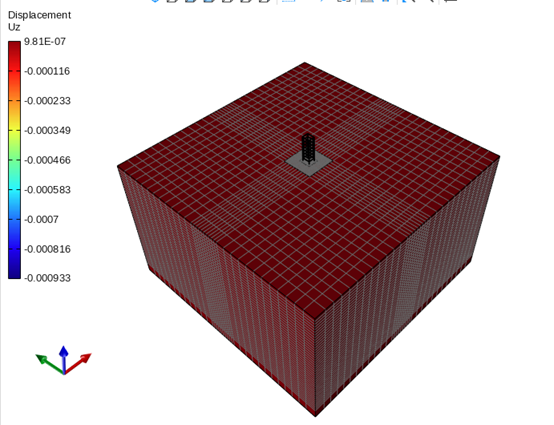
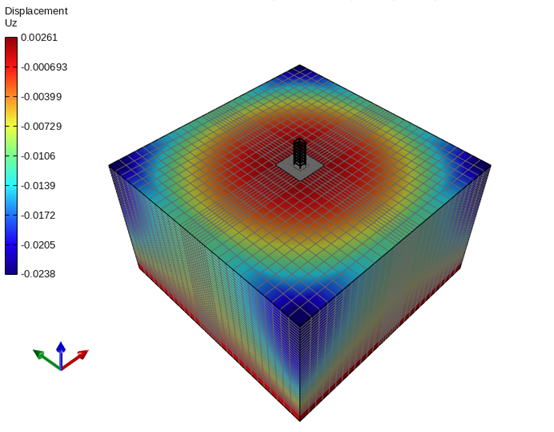
However, the results I obtained showed significant differences. Figures 3 and 4 show the displacement results in the z-direction at the end of the fourth analysis step. Figure 3 shows the results without applying self-weight to the Absorbing Boundary 3D element, while Figure 4 shows the results with self-weight applied to the Absorbing Boundary 3D element. As we can see, the results in Figure 4 are not very good.I suspect that the settings for “InitialStateAnalysis on” and “InitialStateAnalysis off” are causing the discrepancy in the results, but I'm not sure how to adjust them to make the results more accurate.
figure3:
- figure3.png (178.38 KiB) Viewed 498 times
figure4:
- figure4.png (253.05 KiB) Viewed 498 times
So I’d like to ask you: Should I add self-weight to AbsorbingBoundary3D element? If so, in which direction should I adjust it to improve the settlement results? I'm not sure if I've explained my question clearly, but I look forward to your reply.
There’s one more thing I still don’t understand: what does adding `-mat $matTag` mean in the expression “element ASDAbsorbingBoundary3D $tag $n1 $n2 $n3 $n4 $n5 $n6 $n7 $n8 $G $v $rho $btype <-fx $tsxTag> <-fy $tsyTag> <-fz $tszTag> <-mat $matTag>”? The configuration allows for updating the shear modulus in the free field, but I haven’t found any description of -mat $matTag in the ASDAbsorbingBoundary3D source code. I was wondering if there are any relevant seminars or resources available for learning? I’m a beginner, and everything I’ve mentioned above is based on my current understanding. If there are any areas where my understanding is incomplete, please feel free to correct me.
Here is my specific model:
Best Regards
Re: self-weight be applied to the boundary elements
Posted: Mon Jul 27, 2026 10:30 am
by STKO Team
Dear user,
the reason why you don't see the <-mat $matTag> option in the official opensees repo is because this feature is implemented on the 3D version and we are currently testing it on the 2D version. therefore we are still waiting to do a pull request to the official opensees repo.
If you download the unofficial OpenSees installer from Professor Tarque, it contains some of our branches and you will find this feature.
That being said, you also need to apply the self weight condition.
Anyways, we are about to test also the 2D version and do a pull request. I'm quite positive it will be available for the next STKO version
Re: self-weight be applied to the boundary elements
Posted: Mon Jul 27, 2026 1:17 pm
by Alessandro2016
Dear STKO team:
Thank you for your reply. After studying this topic for some time, I’ve become very interested in the AbsorbingBoundary3D element developed by the STKO team. It’s a remarkable achievement, and I’m looking forward to the next version of STKO. I also have a quick question—if you could answer it, I’d appreciate it: Does adding -mat $matTag assign a specific material to the entire free field, or does it simply change some parameters of the free field?
Best regards!
Re: self-weight be applied to the boundary elements
Posted: Tue Jul 28, 2026 7:25 am
by STKO Team
It assigns the material to the free field columns: this allows you to mirror the same nonlinear behaviour you have in the inner soil.
At the same time, the material stored in the FF columns is used to extract an "evolving" G modulus to update the dashpot coefficients. Though not all material models allow for getting a secant shear modulus, so only some materials will be supported.
Re: self-weight be applied to the boundary elements
Posted: Wed Jul 29, 2026 2:16 am
by Alessandro2016
I have a general understanding now, and appreciate your response. We also eagerly await the upcoming release of STKO.