Page 1 of 1
MVLEM Mesh
Posted: Mon Jul 28, 2025 8:55 pm
by Kate_Rhoades
Hello STKO team,
I am working on converting a lumped plasticity frame model to a frame with MVLEM walls to represent a retrofit design of an existing structure. As you can see from the screenshot, I'm having issues with my mesh. I've watched the lectures on meshing and on using the MVLEM to try and troubleshoot. I've applied mesh conditions of structured, quad, and linear, but the mesh still does not look quite right, and of course, when I go to write my input file, I get the dreaded error: "invalid type of element or number of nodes" which indicates that something is wrong with the mesh. I would be super grateful if you can help me diagnose the issue with the mesh.
I would also greatly appreciate it if you can assist me by checking the SFI-MVLEM properties I've assigned since this is my first time using the MVLEM.
Thank you!
Katharine Rhoades
Re: MVLEM Mesh
Posted: Wed Jul 30, 2025 3:05 pm
by Kate_Rhoades
Hello STKO team,
I'm still having some issues with the mesh in the model, is it something to do with the boundary element columns I used? I would really appreciate some insights and solutions to fix the model. Thank you!
Re: MVLEM Mesh
Posted: Mon Aug 04, 2025 10:15 am
by STKO Team
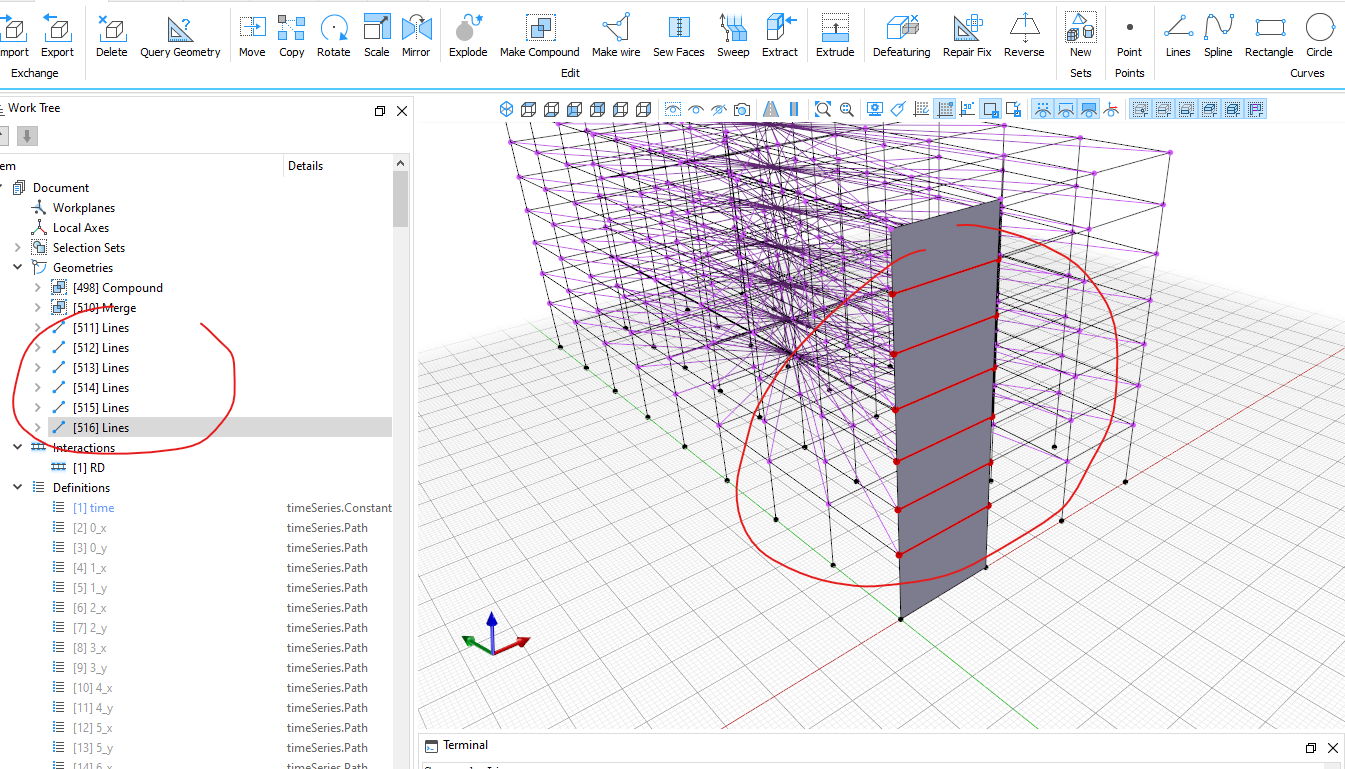
In order to have a quad-structured mesh, your geometry should be made of 4-sided surfaces.
Just create N lines like this, and merge:
- MVLEM_MESH.png (748.21 KiB) Viewed 7843 times
Re: MVLEM Mesh
Posted: Mon Aug 04, 2025 8:09 pm
by Kate_Rhoades
Ohhh! Ok, that worked great! If I'm understanding correctly, it's because when the beam nodes connecting to the sides of the face, the meshing algorithm needs the additional lines to make the faces rectangular between the vertices, right?
One last thing, when I'm running the tcl files I have these messages: Node:setR() - row, col index out of range
It doesn't seem to be affecting the results, but I'm not used to seeing this while I am running my tcl scripts. Is it something in my recorders? Or is it something else?
Thank you!
Re: MVLEM Mesh
Posted: Thu Aug 07, 2025 8:40 am
by STKO Team
Ohhh! Ok, that worked great! If I'm understanding correctly, it's because when the beam nodes connecting to the sides of the face, the meshing algorithm needs the additional lines to make the faces rectangular between the vertices, right?
correct
One last thing, when I'm running the tcl files I have these messages: Node:setR() - row, col index out of range
It doesn't seem to be affecting the results, but I'm not used to seeing this while I am running my tcl scripts. Is it something in my recorders? Or is it something else?
It's not an issue in your model:
R is the nodal partecipation matrix used by the UniformExcitation, and only used when you apply a rotational ground motion (it's used to convert it to an equivalent translational one).
However it assumes that a node has NDF (number of DOFs) >= NDM (number of dimensions), that is, at least the first NDM DOFs are the translational ones associated with the NDM dimensions.
Howeve the MVLEM element allocations internal nodes (to store internal DOFs) where NDF = 1 < NDM = 3...
However, you can ignore it
Re: MVLEM Mesh
Posted: Thu Aug 07, 2025 4:20 pm
by Kate_Rhoades
Ah, ok! That makes a ton of sense, thank you so much for your help!

Re: MVLEM Mesh
Posted: Mon Aug 25, 2025 8:55 am
by STKO Team
You're welcome
Re: MVLEM Mesh
Posted: Mon Aug 25, 2025 9:02 pm
by Kate_Rhoades
I actually have one more question about this model. I am trying to run a pushover analysis, and I am having some difficulties running the pushover to failure. Specifically I think it is because the building is so stiff. Is there any possibility you would be able to help me address the model? I'm wondering if there is a different solver or something I need to use in my horizontal analysis. Thank you!
Re: MVLEM Mesh
Posted: Wed Aug 27, 2025 4:13 pm
by STKO Team
Try this:
I increased the reference load in the load pattern (-factor = 1e4) to make it close to the final load, so that the load multiplier (unknown in the displacement control) is close to 1. Improves convergence of the disp-control.
I made also few other changes. Play with it and see how it goes