Page 3 of 6
Re: How to consider the rotational mass in linear elastic static analysis?
Posted: Tue Feb 23, 2021 4:58 pm
by prasannahannur
Found it. Thank you
Re: How to consider the rotational mass in linear elastic static analysis?
Posted: Wed Feb 24, 2021 1:40 pm
by luckypants
Dear AcetoDivino:
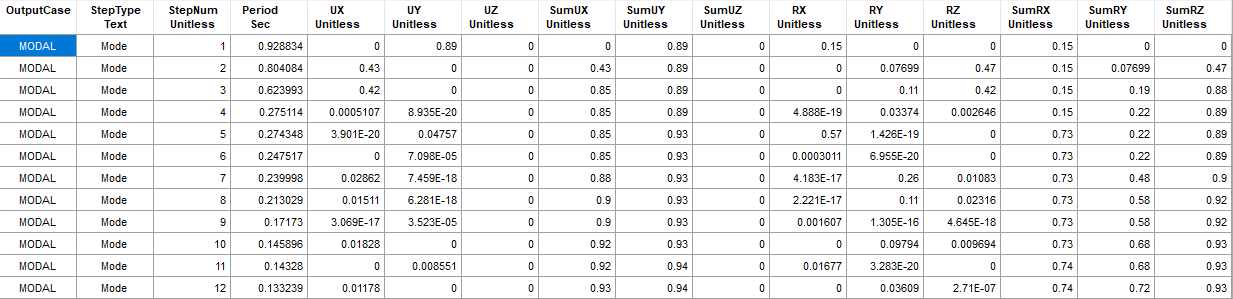
I removed the membranes in ETABS and compare ETABS to STKO. The result was still different.
Here is the ETABS output of the time vs displacement.
Best Regards
Re: How to consider the rotational mass in linear elastic static analysis?
Posted: Thu Feb 25, 2021 10:58 am
by AcetoDivino
Hi luckypants,
I remade the model without walls and membranes on sap2000 and found the same precise modal results as STKO.
SAP2000 Results :
- Image 1.png (25.52 KiB) Viewed 6233 times

- Image 1_bis.png (8.41 KiB) Viewed 6231 times
STKO Results:

- Image 2.png (8.02 KiB) Viewed 6233 times
As I told you in a few posts ago, I set to 0 the multipliers of the shear areas of the sections in SAP2000, but not the torsional constant.
In Sap2000 there are rotational modal masses, but when only translational masses are present in the model, the calculated rotational masses are just a numerical construction.
With these assumptions, the TH analysis should give the same results.
Reviewing your results, I see that the first and second modes are similar (in ETABS), which is strange because, in the 2 directions, the model has quite different stiffnesses. So, I would say that the model done in STKO is more correct. I suggest you revise your model in ETABS.
Anyway, your comparison will be quite interesting, once it is concluded. If you were to summarize it into a document, I guess that the STKO Team would be interested in publishing it.
Luca
Re: How to consider the rotational mass in linear elastic static analysis?
Posted: Fri Feb 26, 2021 6:53 am
by luckypants
Dear AcetoDivino:
Thank you very much.

The problem is solved.
I originally set the multipliers of the shear areas and the torsional constant to 0.
So I changed the torsional constant to 1.
After I completed the analysis, the results of displacement vs time was almost same and the periods of two models were same too.
According to the results, torsion effect is considered for the element elasticbeamcolumn, isn't it?
It is not the same as I thought before. I think I was wrong before.

Best Regards
Re: How to consider the rotational mass in linear elastic static analysis?
Posted: Fri Feb 26, 2021 10:20 am
by AcetoDivino
Hi luckypants,
I'm glad to have been helpful. I meant exactly what you did.
Yes, the ElasticBeamColumns consider the torsion. You can also tell from the input parameters where both J and G appear.
If you make a short report of your experience you can send it to me in a private message! Thank you very much
Kind regards
Luca
Modal analysis results
Posted: Wed Oct 27, 2021 2:01 am
by pucho
Dear STKO team,
I am having a similar problem. I created a model in STKO with shell elements and beam elements for performing modal analysis. However, the results of the solution suing SAP200 and STKO are completely different. The total mass calculated by both programs is the same but the first mode calculated using STKO is 4.26 s, for a two-story masonry house while the value obtained using SAP2000 Is 0.25 s (more realistic).
I will really appreciate your help.
Best regards,
Hernan García
Re: How to consider the rotational mass in linear elastic static analysis?
Posted: Wed Oct 27, 2021 8:03 am
by marafini.f
Hi pucho,
you posted just a picture of your model. Could you zip your file and attach it to the next post?
Anyway, normally an error in the order of magnitude in terms of the period is due to an error in the order of magnitude of the mass application.
Before you attach the file could you please check the units you are using?
Be careful to be consistent with the unit system you choose to model.
For example, if you already have the value of self-weight of your material:
Reference unit system:
N = 1;
mm = 1;
s = 1;
rho = 2000 <kg/m^3> = 2e-09 <(N/(mm/s^2))/mm^3>
g = 9.81 <m/s^2> = 9810 <mm/s^2> (approximated)
thickness = 350 <mm>
sw = rho*g*thickness <N/mm^2> = 6.86e-03 <N/mm^2>
Let us know how it goes.
Enjoy your modeling.
Francesca

Re: How to consider the rotational mass in linear elastic static analysis?
Posted: Wed Oct 27, 2021 12:08 pm
by pucho
Thank Francesca for your fast reply. I checked the total mass (69000 kg) that is given by the program and is equal to the total mass derived using SAP2000. Please can take a look at
my file?
Re: How to consider the rotational mass in linear elastic static analysis?
Posted: Wed Oct 27, 2021 12:13 pm
by pucho
I forgot to ask in the previous post, where can the gravity constant be changed in STKO?
Re: How to consider the rotational mass in linear elastic static analysis?
Posted: Wed Oct 27, 2021 5:43 pm
by pucho
Dear Francesca, I solved the problem using the correct unit transformation as it was described in your post; thank you very much.